Respect
Enter calmly. Listen before interpreting. Never provoke for a reaction.
This is research, not entertainment.
A different approach to paranormal exploration—built on respect, measured with integrity, and preserved with an honest evidence trail.
Invitation channel open
A new kind of paranormal work
Paranormal Invites™ begins with a simple belief: if something is there, it deserves to be approached with the same dignity we would offer anyone else.
This is not about being “the investigator.” It is an invitation—a calm, compassionate approach that creates space for positive, peaceful communication while documenting what actually happens.
“This invitation is sent with respect. Please lift the veil and accept with respect.”
The compass behind every invitation
Enter calmly. Listen before interpreting. Never provoke for a reaction.
Preserve what happened—including silence, uncertainty, and negative results.
Treat every possible presence as a story, not a spectacle.
Invite only positive, peaceful intent. Close every session with care.
Built by Paranormal Invites™
Every tool is developed around traceability: baselines, timestamps, sensor conditions, raw observations, and decision rules that can be reviewed later.
Live Word, Ask a Question, Phonetic, SLS, and session evidence—brought together in one auditable testing environment.
A standalone interaction experiment designed to record every ring event and the conditions surrounding it.
A photo-based visual analysis concept built to outline possible anomalies without hiding the original image.
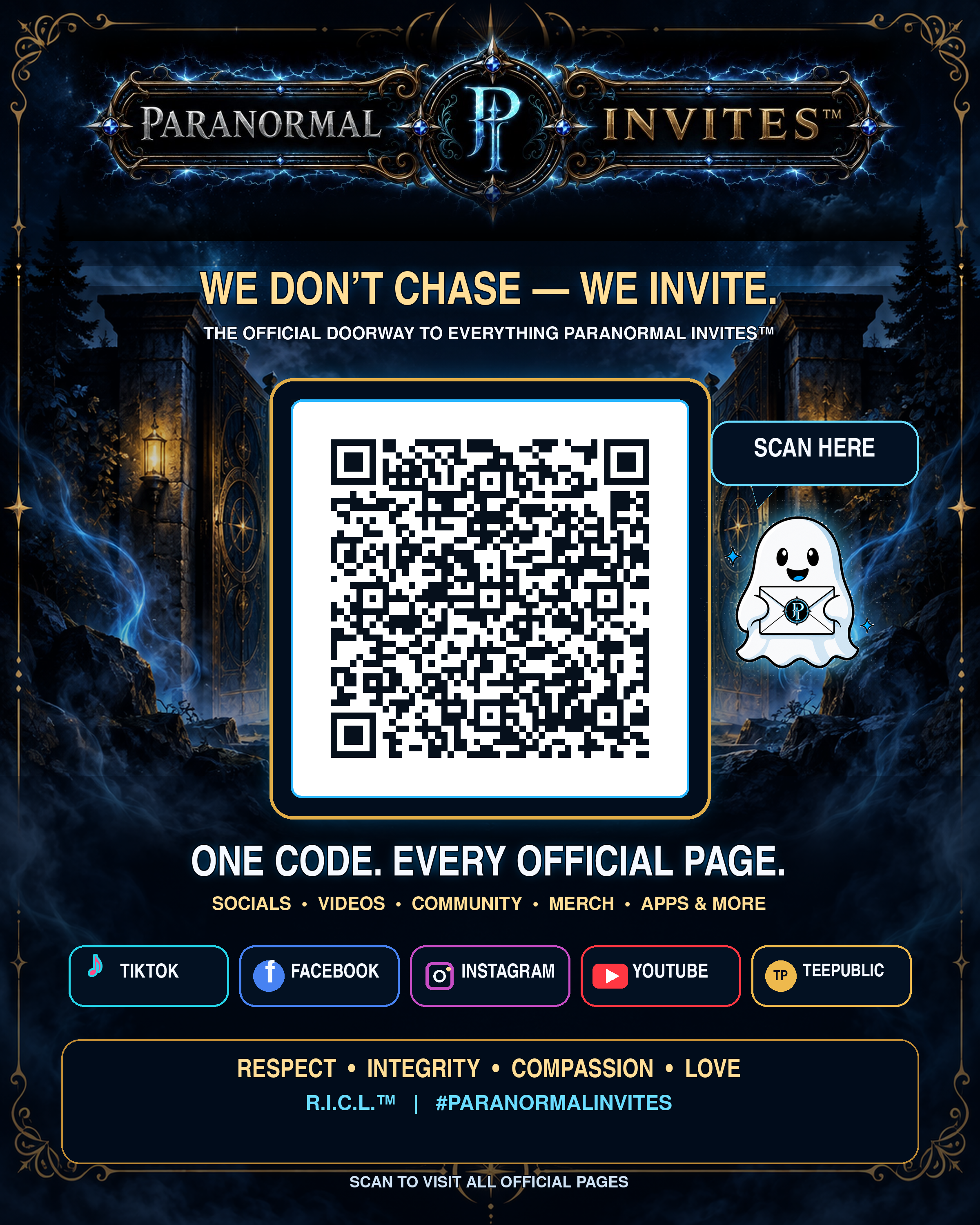 Tap the poster to open every official link
One code. Every official page.
Find Paranormal Invites™ on TikTok, Facebook, Instagram, YouTube, Fourthwall, and TeePublic from one public page. On a phone, tap the poster or button. On another device, scan the QR code.
Public links only. The QR code and button never share an email, password, verification code, saved login, or private account access.
Open all official linksOne clip. Two honest readings.
With the camera held on an empty seating area, the green SLS overlay appears, drops out, and reforms several times around the chair and illuminated equipment.
The system repeatedly maps human-like geometry even though no visible person enters the frame.
It may be an unexplained mapping event, or the pose system may be responding to furniture, objects, edges, or changing light. This clip alone cannot decide between them.
That uncertainty stays visible. We show the event, preserve the context, and invite careful review before making a claim.
Evidence before interpretation
A strange result should lead to questions—not a conclusion. Paranormal Invites™ preserves enough context for a reviewer to follow the complete path from raw reading to final interpretation.
Tap any item to see what it means, a real example, and its privacy boundary.
Open research record Plain-language guide
Paranormal Invites™ records session evidence only when the app has the needed Android permission and the tester chooses to submit it. The public description explains the record without revealing proprietary detection logic.
App-created session results, sensor readings used by the active mode, time markers, baseline conditions, device movement, available radio-state status, app/build information, and notes or session media the tester deliberately creates or submits.
No precise GPS coordinates, contacts, passwords, login or verification codes, texts, emails, call history, browsing history, banking information, or unrelated photos, videos, and files. We do not track a tester’s live location.
Location privacy: If a tester chooses to add location context, the research record uses only a broad area such as a city or an approximately 50–100 mile region—not a home address or precise coordinates.
What it means: We preserve the original readings and app-created session material so a reviewer can inspect what happened before edits or conclusions are added.
Example: The sensor values surrounding an event, an audio-level window, a word or answer produced during the session, or an SLS frame created inside the active mode.
Privacy boundary: This does not mean unrestricted access to the phone. It does not pull contacts, personal messages, passwords, or unrelated camera files.
What it means: Time markers let reviewers place every recorded event in the correct order and compare it with the rest of the session.
Illustrative example: Baseline began at 00:00, the session armed at 03:00, an event appeared at 18:42, and the session ended at 24:10.
Privacy boundary: A timestamp records when an app event happened. It does not reveal calendar entries, messages, calls, or browsing activity.
What it means: A baseline gives the app a reference for the room or area before results are evaluated. Events are considered against that starting condition.
Example: The app records the normal sensor range and ambient audio level in Room A before Live Word or another research mode is armed.
Privacy boundary: A room baseline is not a map of the home and does not identify a street address or precise GPS position.
What it means: Available motion-sensor readings help show whether the phone was still, lifted, bumped, or moved close to an event.
Example: A spike at 18:42 is reviewed beside the movement record to see whether someone picked up the phone at the same moment.
Privacy boundary: Movement checks describe the device during the session. They do not follow a person after the session or track where that person travels.
What it means: Where Android permits, the record notes whether Airplane Mode, Wi-Fi, Bluetooth, cellular service, and NFC were on or off at the beginning and end of a session.
Example: A controlled session may show Airplane Mode on and Wi-Fi, Bluetooth, cellular, and NFC off.
Privacy boundary: Radio state is an on/off or availability condition. It does not collect Wi-Fi passwords, browsing history, message contents, calls, or data from nearby devices.
What it means: The app version, build, active research mode, and ruleset identifier are locked to the record so later software changes cannot be confused with earlier results.
Example: Two sessions can be compared only after confirming they used the same build and the same version of the event-detection rules.
Privacy boundary: This identifies Paranormal Invites™ software—not other apps installed on the tester’s phone. Proprietary source code and detection formulas remain protected.
What it means: A negative result means the app produced no qualifying word, phonetic sound, answer, or other mode output. It does not automatically mean every sensor stayed inactive. Sensors may still register changes that remain below the level required to produce a response.
Example: A ten-minute Phonetic session produces no qualifying sound, but its preserved sensor record may still show below-threshold activity. Keeping both the no-response outcome and those readings allows comparison with other rooms, locations, and sessions where an output was produced.
Privacy boundary: A negative result describes the session outcome. It is not a score, judgment, or performance rating for the tester.
What it means: Anything that could reasonably influence a result is attached to the record so reviewers can weigh the event honestly.
Example: The phone moved, someone spoke, wind crossed the microphone, a notification occurred, nearby electronics were active, or another person entered the area.
Privacy boundary: The note may say that a notification interrupted the session; it does not copy the notification, message, sender, or account information.
Deep dive 01 Research standard
The event is recorded first. Meaning is considered only after the original material, the surrounding conditions, and reasonable competing explanations have been preserved.
Describe what happened before deciding what it was.
People naturally search for meaning in incomplete information. Once a striking explanation takes hold, later details can be selected, remembered, or described in ways that support it. That does not make the witness dishonest; it makes a disciplined record essential.
Leading with evidence creates a pause between experience and conclusion. It gives the unusual event room to remain unusual while protecting it from exaggeration, memory drift, and claims the material cannot support.
Knowing what we hope to find can influence what receives attention.
Ambiguous shapes or sounds can feel meaningful before they are tested.
Later discussion can quietly change how an event is recalled.
Remarkable moments can overshadow the silent or contradictory results.
Observation
Describe only what can be located in the source: what appeared, when it happened, how long it remained, and which instrument recorded it.
Example: “At 18:42, the SLS overlay formed a figure-shaped map beside the chair.”
Interpretation
List more than one plausible reading, including ordinary causes. Interpretations are possibilities to test—not facts to insert into the record.
Example: “The map may be anomalous, or the pose system may be resolving furniture and light as a body.”
Claim
A claim comes last and must remain no stronger than the record. When the cause is unknown, “unresolved” is a complete and honest conclusion.
Example: “This is an unresolved visual-mapping event—not proof of an entity.”
Preserve the untouched source file and the full session—not just the exciting excerpt. Editing, enhancement, and social-media copies belong in separate derivatives.
Record time, location, device, app and algorithm version, session mode, environmental conditions, baseline period, and every person present.
Log movement, voices, notifications, radio traffic, nearby electronics, airflow, reflections, recognizable shapes, and anything handled during the event.
Attempt to recreate the result. Change one condition at a time, remove likely sources, and compare the event with baseline and control runs.
Each witness records what they noticed before group discussion. Firsthand observation stays distinct from later review and interpretation.
Choose the narrowest outcome the record supports. Unknown does not automatically mean paranormal, and a negative result is still useful evidence.
A documented ordinary cause accounts for the result or reliably recreates it.
Important context is missing, compromised, or affected by a known source. No strong conclusion is possible.
The event remains unexplained after reasonable checks, but the evidence does not identify a cause.
Independent records align in time under documented conditions, making the event a stronger candidate for further study.
The label describes the strength of the record—not the identity of what caused it. “Paranormal” is not a shortcut around missing information.
An event exists in an original file.
Time, conditions, equipment, baseline, and session history are attached.
Ordinary causes and contamination have been actively examined.
Independent sensors, recordings, witnesses, or repeat trials align.
An unusual result becomes more useful through context, controls, repetition, and independent correlation—not through more dramatic language.
Current classificationUnresolved mapping event
The camera remains on an apparently empty seating area while the green SLS overlay appears, disappears, and reforms near the chair and illuminated equipment. No visible person enters the framed area.
The clip alone does not reveal why the pose map formed. It cannot distinguish an anomalous event from a false human-form match caused by furniture, edges, equipment, lighting, movement, or the model itself.
Responsible wording: “This clip preserves an interesting visual-mapping event that remains unresolved. It warrants controlled follow-up, not a declaration of proof.”
Questioning an event does not weaken it.
The invitation is growing
Paranormal Invites™ is preparing a carefully managed tester program for people who value patience, respect, and complete reporting—not manufactured activity.
Tester applications are opening soon.